Way back when Tony Ortega’s bosses in Phoenix were dreaming about shredding and burning all the evidence implicating them in the global sex-for-profit scandal that was starting to spiral so out of control they were once again at risk of going to prison, a deal was struck.
Tony Ortega was promised that as long as he toed the party line and played nice, he’d be rewarded with an executive assignment as chief editor at a far “more lucrative and prestigious” rag than the “lowly” _Village_Voice.
The vast majority of women who are raped or sexually assaulted do not report the crime to police, as surveys in light of allegations facing Supreme Court hopeful Brett Kavanaugh suggests. Tragically, this is so because in many cases because the victims have little confidence that their attacker will ever be brought to justice.
Once recent poll found that 1 out of 6 women have experienced some form of harassment, while 35 percent have been sexually assaulted.
In our last post we referenced the bipartisan support that lead to The U.S. Senate’s condemnation of Backpage and its vocal supports when it voted overwhelmingly in February to close an Internet law loophole that has shielded Backpage from liability when they ran ads for minors being offered as prostitutes.
The law this amends, the Communications Decency Act of 1996, was intended to foster an open Internet free of threats of lawsuits for content some might dislike.
Back on January 10, 2017, it was a day of reckoning on Capitol Hill for the Backpage, when the Senate Permanent Subcommittee on Investigations released a new report saying that Backpage had knowingly facilitated underage trafficking on its site by actively editing ads posted in the “adult services” section. It was then that website’s top executives were subpoenaed to attend a hearing where the Subcommittee, led by Sen. Rob Portman and McCaskill laid out their findings, which were based on over a million pages of internal company documents.
For as much as we’ve talked about the dangers of Tony Ortega’s hate-blog and the work of his former employers at the sleazy sex selling site, Backpage, it could be helpful to take a moment to set each in its proper context.
For example, Tony Ortega’s ‘angry troll on the internet’ routine generates so little actual revenue that it really must be considered more hobby than ‘job’. For all the time Ortega seems to fritter away over his pet obsession, he must be making embarrassingly little money from it – what’s more embarrassing is that he is living off of his wife, Arielle Silverstein, salary.
The more one examines Tony Ortega’s involvement as Editor-in-Chief of his former rag, the Village Voice, and how he defended their attempts to make money off of sex trafficking the sicker one gets.
We know have incontrovertible proof in the form of first-hand, corroborated accounts (as described in affidavits to the Court by victims and witnesses alike) that it involved child sex slaves. This disturbing fact is something which Ortega has continuously downplayed, in a desperate attempt to minimize it away.
Yesterday we took a look at how everything that Tony Ortega touches dies. Though the scope of our discussion was based on the disastrous litany of Tony Ortega’s failed employment history, this deep underlying truth about Tony can tragically be applied to numerous Jane Doe’s who have suffered at the hands of the Backpage, the one-time market leader for online human trafficking which Tony vociferously publicly defended time and time again.
Ashley Benson was a victim of sex trafficking who was brutally murdered by a man who bought her off the internet for sex using the Backpage website, the largest sex trafficking site this country has ever seen.
Benson was a young mother who was trying to put her life together for her son, but she was picked up by a pimp who physically and mentally abused her and then forced her to have sex with strangers for money.
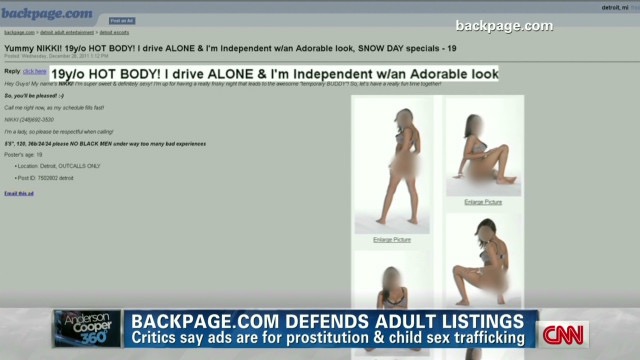
We know from past reporting that Backpage refused to impose meaningful requirements before sex ads were posted on their site because they believed the Communications Decency Act would give them immunity from suit for child sex trafficking. They also believed requiring photo identification would substantially reduce their profits, and harm their bottom line.
Rather than take any reasonable steps to prevent children from being advertised for sex on their website, the Backpage intentionally underreported the number of child sex ads on their website.
Our last post discussed how Backpage attempted to characterize itself as ‘Sheriff of the Internet’, much in the way the proverbial fox would guard a henhouse.
They tried to create relationships with various law enforcement agencies in what amounted to nothing more than a PR strategy which sought to control the narrative around its involvement as the country’s largest platform for sex trafficking. In short, they weren’t content to skirt the existing system of law enforcement in place to guard against its practices, they wanted to rig the system to make themselves look like the good guys.
In or around 2010, as the Backpage began to emerge as a significant presence in the online sex advertising business, they developed a plan to minimize the attention devoted to its activities by the public and by law enforcement agencies, particularly concerning advertising of children on its website.
Defendants undertook to forge seemingly cooperative relationships with many law enforcement agencies and to convey the impression that they were actively and successfully engaged in efforts to identify and report child sex trafficking victims and otherwise “partnering” with law enforcement to minimize the risk of exploitation of children on the website.
Deceit through obfuscation. In every sense, this could have been a motto for the Backpage during the time Carl Ferrer was Tony Ortega’s superior at the helm of the largest sex trafficking platform the United States has ever known.
This week we’ve been looking at how Ferrer directly reached out to pimps and traffickers in order to help them beat the bogus ‘monitoring’ system put in place which Backpage had hoped would somehow fool investigators.
We wrote previously as Editor-At-Large Tony Ortega from 2007 to 2012 oversaw the sleazy Backpage’s “posting rules” and “content requirements.” But Ortega went further by publicly attacking anyone in the press who raised questions about the Backpage’s roll as the country’s leading sex trafficking platform, referring to reports of rising rates of underage prostitution as “bogus information”.
“The actual data behind this ‘epidemic’ is wanting in the extreme,” Ortega wrote, following an “investigative” article, paid by revenues directly acquired by Backpage’s advertising sex for money scheme.
Defendant Carl Ferrer, who has been the CEO of Backpage for many years, personally helped one sex trafficker ensure that his sex trafficking ads would be posted on the website after the Backpage locked his account for posting an ad for sex.
As previously reported this sex trafficker went by the username “Urban Pimp.” When his ads were temporarily blocked, he complained to the Ferrer that his sex ads were blocked and noted that he was trying to post sex ads in more than 50 cities in the United States.
On August 17, 2018,Dan Hyer, Sales and Marketing Director of Backpage.com pleaded guilty to conspiring to facilitate prostitution, Hyer participated in a scheme to give free ads to prostitutes in a bid to drive business to Backpage. Hyer is yet another Backpage employee to plead guilty. He will be sentenced in November 2018.
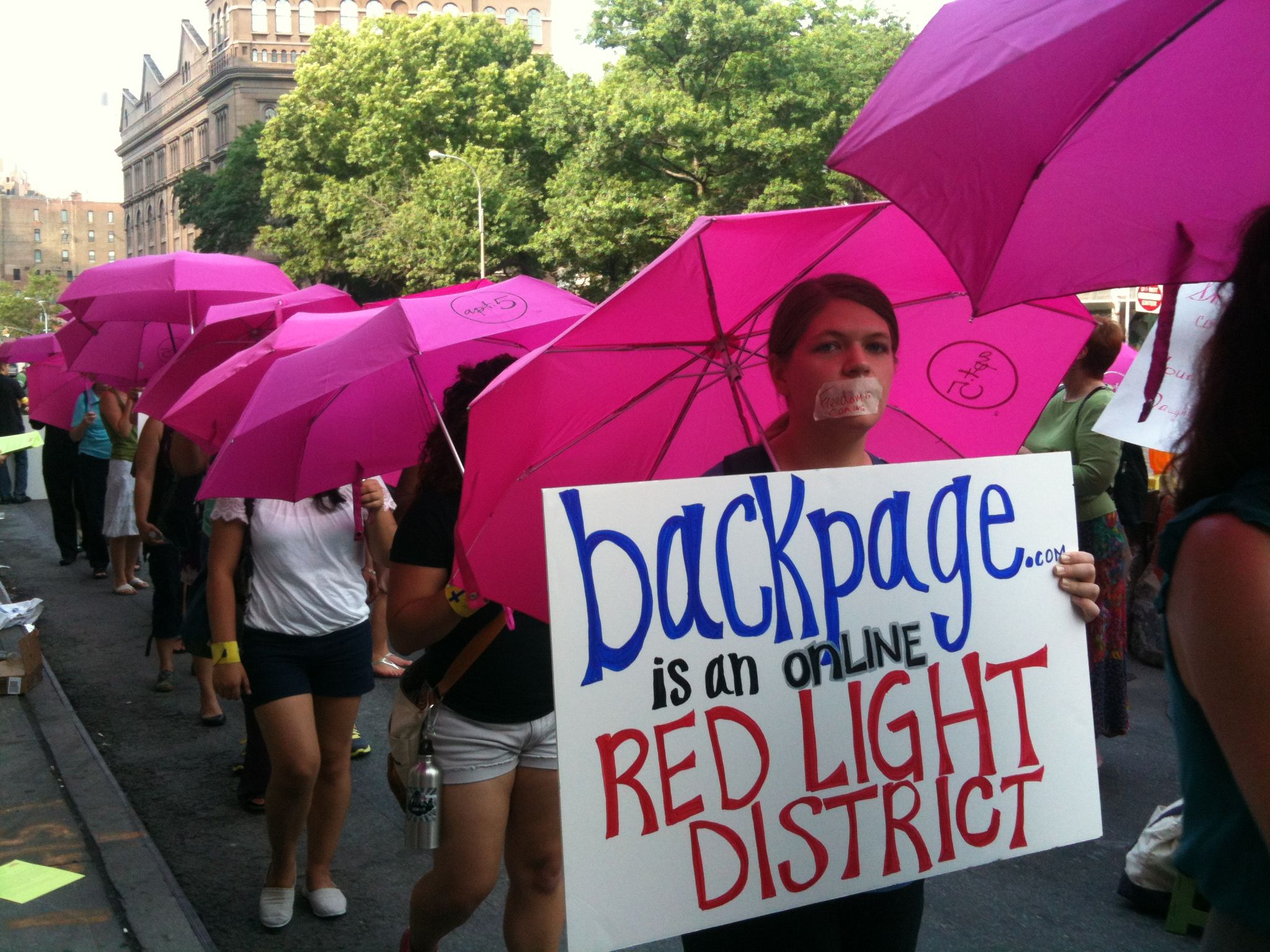
Michael Lacey and James Larkin, who owned the Backpage trademark attached “Backpage” online sex trafficking site to the Village Voice.
Florida Abolitionist, Inc. is a non-profit organization in Orlando, Florida with a mission to combat and end human trafficking and other forms of modern day human slavery. It provides direct services to trafficked adults and children.
In a new lawsuit, Florida Abolitionist has filed against the men behind Backpage, it alleges Backpage knowingly participated in, and facilitated, sex trafficking. By doing so Backpage has increased the number of trafficked adults and children that Florida Abolitionist treats.
Carl Ferrer, Michael Lacey, James Larkin
Anthony “Tony” Ortega
After Backpage.com created the marketplace, Tony Ortega helped sex traffickers create and develop the content of their ads on the site so they could profit from each ad.
When law enforcement began to scrutinize the illegal activity occurring on Backpage, Ortega’s bosses took steps to help sex traffickers create ads that would avoid detection by law enforcement so that they could continue to profit from those ads.
By the time the Feds shutdown Tony Ortega’s former employers’s Backpage.com, it was largest source of online human sex trafficking in the United States.This chilling fact, seemingly the one subject upon which Tony Ortega is conspicuously silent, is not disputed.
That Backpage conspirators generated $135 million in revenue, the vast majority of which was generated from illegal ads for sex on the Backpage,is not disputed.
The facts above are not merely coincidental.
It’s no coincidence that as state and federal investigations of Backpage continue heating up, the pressure on Tony Ortega is mountings significantly. Case in point – most of his blog posts lately have been shorter than usual and/or written by “guest” authors who help ramp up his cult of personality as the preeminent “Scientology expert” on the Internet.
Ortega has made a ‘career ‘, if such a word can be applied to a chronic malingerer, of making a mountain out of a molehills.
Harvey Weinstein’s downfall began when the first of his victims began to speak out. The Paul Haggis rape case began when the women he allegedly raped chose to come forward. The MeToo Movement itself only became a force for change as women found the courage to take a stand against their abusers.
Earlier this year in state district court in Harris County, Texas something similar began when a human trafficking survivor, Jane Doe #1, filed a groundbreaking lawsuit against Tony Ortega’s former Backpage employers and the Houston-area hotels and truck stops where she was allegedly exploited, according to her lawyers at Annie McAdams PC and Sico Hoelscher Harris & Braugh LLP.