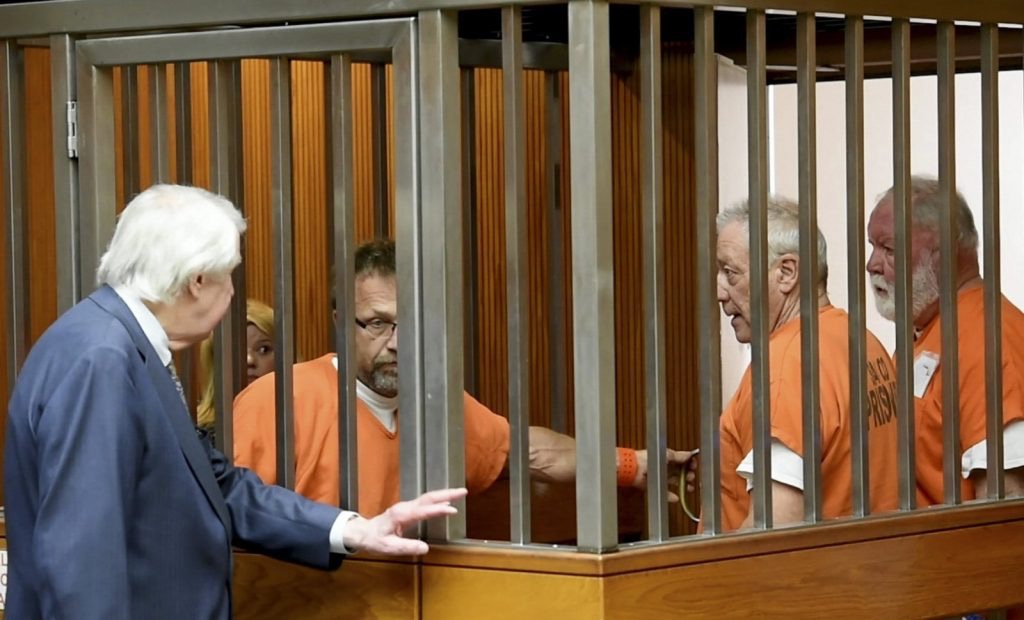
Two weeks after Fosta-Sesta passed, Carl Ferrer appeared in a closed federal courtroom in Phoenix. He pleaded guilty to conspiracy to facilitate prostitution and launder money, surrendered Backpage and its assets, and promised to cooperate with federal authorities.
A day later, the Feds nailed Michael Lacey and James Larkin in Phoenix, charging them and five other Backpagers under long-existing criminal statutes. As many legal experts pointed out, the move suggested that the government never needed Fosta-Sesta to prosecute the pair; the president had yet to even sign it into law by the time the hammer fell.
On the day SESTA (the Stop Enabling Sex Traffickers Act) was introduced, the Internet Association—an industry consortium that represents Airbnb, Facebook, Google, Twitter, and more than three dozen other tech companies—released a statement criticizing the bill that would effectively end Lacey and Larkin’s dream of the Backpage sex trafficking empire, calling it “overly broad.”
While it was of vital important to pursue “rogue operators like Backpage.com,” the association said, SESTA was more butcher knife than scalpel; it would create “a new wave of frivolous and unpredictable actions against legitimate companies.
On January 8, 2017, the Senate subcommittee released its final report, titled “Backpage.com’s Knowing Facilitation of Online Sex Trafficking.” It pushed the theory that Lacey, Larkin, Ferrer, and their employees had invalidated their liability protections under Section 230: Rather than removing illegal and obscene content, the Senate clearly established that Backpage had helped develop it, using manipulative moderation practices to “sanitize the content” and conceal it from the eyes of the law—all in the name of earning a few extra dollars.
We have seen how Backpage had used litigation tactics by manipulating legal loops to keep from itself from facing the music.
Most courts had had no choice but to grant them temporary victories because of the unduly broad language of the Section 230 loophole.
But following the subpoena blitz we previously reported on, Portman and his colleagues on Capitol Hill had what they considered incontrovertible evidence in the way of Backpage’s own internal communication.
It’s no secret Michael Lacey and James Larkin built on the backs of (let’s be generous here) ‘questionable’ motives and a couple of key legal loopholes.
With Section 230 as their weapon, they pushed their way into the court system. At first it seemed the side of law and decency was losing after the slimy Backpage duo won an early series of civil suits, successfully challenging anti-Backpage laws in New Jersey, Tennessee, and Washington State.
“They love to inflate the numbers by talking about children ‘at risk’ of exploitation.”
That was how Backpage boss Michael Lacey characterized the work of the experts at the Crimes Against Children Research Center on the subject of child sex trafficking. In that statement, Lacey highlights his callous indifference to suffering victims and blinding concern for his own self-interest. If there were any question about Larkin and Lacey’s desire to help authorities put out the fire Backpage started, let this quote serve as a reminder to their true state of mind on the subject.
Backpage was already getting into hot water. A girl in Missouri had sued the site in mid-September of 2009, alleging that she’d been pimped out at the age of 14 and that Backpage had willfully “failed to investigate for fear of what it would learn.” In the official police report she explained that the site’s operators “had a strong suspicion” she was underage. Ultimately, a federal magistrate dismissed her case. The situation was tragic, the judge said, but Backpage was protected under Section 230.
The Communications Decency Act was a law conceived, as the name suggests, to rid the web of vice.
The new act was proposed in 1995 by Senator J. James Exon, a Nebraska Democrat who’d watched with growing alarm as “the worst, most vile, most perverse pornography” spread online. He was particularly concerned about what all this obscenity might do to America’s children.
Although Exon repeatedly described the legislation as “streamlined,” the Department of Justice warned that its indecency provisions were unconstitutionally broad.
Last week we took an insider’s look at two sex peddlers behind the online trafficking empire known as Backpage.
Today we continue our deep dive into the perverse path Backpage blazed without a thought to the host of victims it would leave in its wake to become the undisputed worldwide heavy-weight champion of human sex trafficking.
James Larkin had decided early on in his partnership with Michael Lacey that the fasted way to set their scheme in motion was to concentrate maximum effort on expanding their advertising market, specifically through increasingly risqué sex ads in the site’s personal’s section.
As of this writing both Mike Lacey and Jim Larkin are out on million-dollar bonds, secured by real estate the government eventually hopes to own when it wins its case against Backpage. The bulk of the charges against them fittingly fall under the Travel Act, a law designed by Robert F. Kennedy’s Justice Department to target organized crime. According to the indictment, Lacey, Larkin, and their underlings like Tony Ortega not only turned a blind eye to prostitution and child sexual trafficking but, driven by greed, actively worked to abet it.
As readers familiar with the sordid saga of Tony Ortega’s “Free Speech Champions” might recall from our earlier reporting, Backpage, the platform that brought the federal government down on Michael Lacey and James Larkin’s heads, itself wasn’t much to look at. It was little more than a bare-bones interface wrapped in knock-off Facebook blue. From the beginning it was similar to Craigslist in both form and function. Even its name was something of a callback to the old days of print publishing, when classified ads (especially racier ads for topless bars, escort services, and other sexually oriented businesses) filled the final pages of alt-weeklies.
In Michael Lacey’s younger and more vulnerable years, his father gave him this advice:
“Whenever someone pokes a finger in your chest, you grab that finger and you break it off at the knuckle.”
Lacey had grown up in the 1950’s as a bright, bookish boy. His father, a sailor turned enforcer for a New York construction union, had little use for his son’s intellectual gifts. If Lacey lost a fight at school, he says, his dad “came home and beat me again.
Tony Ortega
We first brought you the story about the explosive rise in one state’s sex trafficking charges as Backpage was at the height of its vile powers. Today we continue our examination of Florida, in light of the recent headlines in which a young woman of 19 was kidnapped and forced into a life of Backpage prostitution in Boynton Beach.
Stalwart defender of Backpage’s heinous practices, Tony Ortega, once bragged about his bosses when he said, “ The people I work for were smart enough to start Backpage.
Marco Orego
Recently we received a question from a reader who mentioned a terrifying story about a man facing a life sentence for the role he played in prostituting a young girl using Backpage in 2017.
The reader asked if we might take a closer look at what is happening in Florida with regards to Backpage sex trafficking and what we discovered concerned us deeply.
More than 20 million people are subjected to forced labor every year, and 22% (4.
We here have spent more than our fair share of time reading about the Backpage. The sickening familiarity of the countless stories of those victimized by this soulless corporation willing to sell children to sex pests for cold, hard cash never ceases to appall us.
Tony Ortega might celebrate the Backpage as a “First Amendment Rights” champion but, like so many of Ortega’s ‘opinions’, the lie at the center of his thinking is only too clear for anyone with sense enough to see past the dog and pony show of his wholly manufactured, self-righteousness.
We previously informed our readers of the precedent-setting move made by the authorities in the state of Delaware after they summarily invalidated the business licenses of four companies who had worked to support Backpage in its quest to sexually traffic as many children as it could to boost its bottom line.
More background has come to light on this encouraging new ‘zero policy’ towards those who aid and abet blatantly criminal organizations like Backpage.
In what some in the legal world are calling ‘a sign of things to come’ the Delaware state Attorney General’s Office issued a truly inspiring judgment the other day when they took the as-yet unprecedented step of revoking the right of four companies linked to Backpage from doing business as legal entities.
The loss of their LCC certification was made possible through legislation enacted last year that permitted the state Department of Justice to ask the court to cancel certificates of formations due to abuse or misuse of its limited liability company powers, privileges or existence.
Whatever mounting pressure Tony Ortega is feeling as the noose of justice tightens around him in the wake of weeks and weeks of Backpage headlines being splashed on headlines across the country must finally be taking a toll. It’s been a while since we checked in with his fictional blog where he once more gets to play-pretend he’s a real big-boy journalist. Spoiler alert, Ortega is not a reporter. Given his recent misadventure in publishing blog spam, he just might be the new poster boy for intellectual property theft though.
We first reported to you last week about a 32 year federal prison conviction for the man who trafficked 16-year-old Desiree Robinson of Chicago. The girl was subsequently murdered by a man she had been sold to on Backpage. While the actual murder awaits trial for the part he played in destroying the innocent girl’s life, we now receive news of another important sentence connected with this tragedy — one that may yet have implications well beyond this single case.
We’ve been witnessing a lot of positive momentum in the recent spate of successful Backpage prosecutions and while this is encouraging news it is important to remember that though the site has been outlawed by the Federal Government, reverberations of the damage it’s caused continue to echo.
This week a number of news outlets picked up on something longtime readers of this blog will be well familiar with: the scourge of the sex trafficking model Backpage popularized is increasingly being adopted by other platforms.