Backpage Exposed: You Can’t Deny The Undeniable
 Andrew Padilla
On April 5, 2011, Andrew Padilla sent an email whose recipients included Joye Vaught and the supervisor of Backpage’s Indian moderation team. True to Backpage’s abysmal moderation standards the email was entitled “relaxed image standards”. It included, as an attachment, a document that displayed a series of 30 nude and partially-nude photographs. Next to each picture was an instruction as to whether it should be approved or disapproved by a moderator. One picture showed a woman sitting on a bed, wearing only a bra and panties, with her legs spread open and her hand partially covering her crotch.
The caption provided in part: “ _okay -but barely._”
Between April 2011 and March 2012, Padilla, Carl Ferrer and others participated in an email exchange acknowledging that Backpage was deleting thousands of pictures from customer ads each week and seeking assistance in collecting all of the deleted pictures so they could be used for, and we quote, “entertainment” or to generate user “traffic for other projects.”
The email explained that the deleted pictures could be made available to the public on a new website called “nakedpics.backpage.com” or “badpics.backpage.com” in an attempt to further exploit the women and young girls who were using their service.
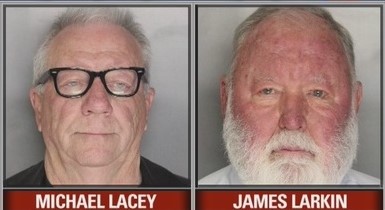
It was then, sometime around mid-April 2011, that James Larkin and Scott Spear received an email seeking permission to terminate the contract of a third-party vendor that had been receiving $17,000 per month to “remov[e] any nude pics” from the expired ads in Backpage’s database. Perhaps aware that third party moderation was making their job of sex trafficking their victims that much harder, Larkin responded simply: “ do it!”
Early that summer, Carl Ferrer received an inquiry from a law enforcement official about a particular ad that included the term “amber alert.” In response, Carl Ferrer acknowledged this might be “ _some kind of bizarre new code word for an under aged person._“
Ferrer. then forwarded this exchange to Padilla and stated that he had instructed Dan Hyer to add “amber alert” to Backpage’s “strip out” list. In other words, Hyer, Padilla, and Carl Ferrer were making it explicit that they would not require all future ads involving this particular coded term for the prostitution of a child to be blocked from Backpage.
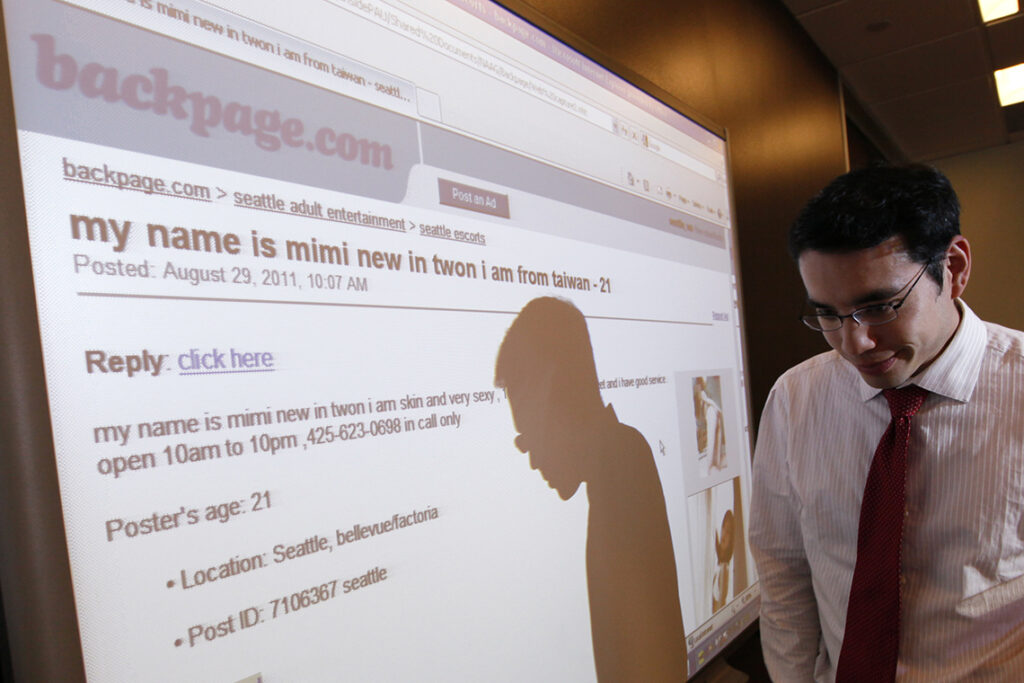 Washington state assistant attorney general Jonathan Mark. (Credit AP Photo/Elaine Thompson)
On June 30, 2011, several Backpage representatives met with representatives from the office of the Washington State Attorney General. During this meeting, the Backpage representatives initially attempted to claim that no prostitution ads appeared on their website.
In response, representative from the Attorney General’s office stated:
“You mean to tell me that if someone responded to an advertisement, the woman they called for services would be offering to go out for coffee?”
It was at this point a Backpage representative gave away the game, according to court documents, when he responded to this question by looking at Carl Ferrer laughing, and acknowledging that Backpage couldn’t possibly “ _deny the undeniable._”
Backpage had full knowledge of what they were doing and were actively engaged in a massive company-wide cover-up, with the assistance of their chief apologist, Tony Ortega.